Successful High Court defence for the Defendant in an e-bike collision claim arising from an accident at Trafalgar Square
The Claimant, riding an e-bike, was travelling around Trafalgar Square shortly before midnight, on his way home. His route took him past The Mall on to the next turning, Cockspur Street, towards Pall Mall. As he passed The Mall, the Defendant, driving a London taxi, crossed the Give Way line governing traffic joining the roundabout from The Mall and collided with the Claimant, causing a nasty fracture of the Claimant’s left knee. After surgery, the Claimant had returned to his work as a cleaner, but the medium-term prognosis was for a total knee replacement and the matter was issued in the High Court.
The Claimant had no clear recollection due to the passage of time, and neither the Defendant nor his passenger (both of whom had given a statement) attended to give evidence. The accident was, however, captured on two separate CCTV cameras on Trafalgar Sq, and in particular from one on The Mall, directly behind the Defendant’s vehicle. 450 still frames were extracted from the CCTV footage, all of which allowed for a proper review of the accident. No engineering evidence was adduced and the matter fell to be analysed qualitatively by Counsel and the Court.
What was apparent was that the Defendant was initially waiting at the stop line at a red light on The Mall. He was in the left hand lane of two, with a car to his right. Beyond the Defendant’s stop line is a pedestrian crossing and then, about a car length beyond the crossing is a Give Way line at the entrance to the roundabout proper.
Initially, as the Defendant waited at his red light, the Claimant proceeded around the roundabout with the lights in his favour. The Claimant was in the right-hand lane and was tucked into towards the centre of the roundabout. He was wearing a dark jacket, but lighter trousers, and had lights on his bike.
The phasing of the lights is such that the Claimant’s light would turn red and the Defendant’s light would then turn green. The CCTV only showed the Defendant’s light.
As the Defendant’s light turned green, a pedestrian stepped out on to the crossing in front of him from the nearside and crossed from left to right. The Defendant (and the car to his right) waited to let the pedestrian cross before setting off. As he did so, the Claimant passed through a red light on the roundabout proper, still tucked in towards the centre of the roundabout. The pedestrian and the street furniture and in particular an old, bulky, lamp post, potentially served to restrict one’s view to the right when at the crossing, but the view opened up as one approached the Give Way line.
As the Defendant approached the Give Way line, the Claimant was there to be seen, but still tucked in towards the centre of the roundabout. As the Defendant went to cross the Give Way line, the Claimant took a course towards the left hand lane of Cockspur Street. He did not signal. He passed in front of the Defendant’s vehicle as the Defendant pulled across the Give Way and a collision occurred with the front of the taxi only a couple of feet across the Give Way.
The Claimant accepted that he had been negligent in passing through the red light, but averred that the Defendant had been negligent in passing through the Give Way line when he was there to be seen, and that as a vulnerable road user on a bike, the Defendant was under an obligation to take particular care for his safety.
The Defendant’s statement stated that he did not believe that the line at the junction required him to stop and give way at the time as the traffic was controlled by a traffic light system.
The case advanced on the Defendant’s behalf was that the standard of care has to reflect the reasonably competent and careful driver, not a perfect one (c.f. Rai v Advantage Insurance Co. Ltd [2026] EWHC 784 (KB)) and that he could not have predicted that the Claimant would pass through the red light and then change lanes directly across his path as he emerged through the Give Way line, not least because there was no signal from the Claimant and the change of lanes was very late.
The Decision
The correct analysis (c.f. Gray v Gibson [2014] EWCA Civ 355) requires the Court to determine (a) whether the Defendant was negligent, (b) whether the Claimant was negligent and (c) if and only if both parties are negligent, the appropriate apportionment of blame.
The Court found that the Claimant was there to be seen as the Defendant came past the pedestrian crossing, but that on his arrival at the Give Way line, the Claimant was still to the far side of the far right lane, and was not in an area of the road where a reasonable driver might need to have regard to his presence. Thereafter, as the Claimant came across the lanes towards the exit, the Defendant was already positioned to turn left on to the roundabout and there was insufficient time for him to see and heed the Claimant’s presence and approach. Accordingly, the Defendant was not negligent in crossing the Give Way line at that point, nor was there evidence that he could have stopped or swerved to avoid the Claimant once the Claimant committed to his manoeuvre. The Claimant accepted that he had been negligent, but there was no equivalent negligence on the part of the Defendant and the claim was dismissed.
Whilst the matter turns on its facts, the key takeaway is that the standard to be imposed on a driver is still only that of the reasonable driver in all the circumstances, rather than a counsel of perfection. The combination of the accident happening at night, the Claimant passing through a red light, the Claimant’s initial position on the road, the lack of a signal and the lateness of the manoeuvre all meant that the Defendant could not be faulted in not appreciating the Claimant’s presence or approach when he decided to pull out. The claim was therefore dismissed.
Why It Matters
Initially, the Defendant’s insurers had admitted primary liability, having regard to the fact that the Defendant had pulled out across a Give Way line onto a roundabout. They then withdrew that admission and made no offers, notwithstanding the risks involved.
Counsel for the Defendant took the tactical decision not just to not call evidence (absent the witness, he could not in any event) but not to rely on the Defendant’s witness statement as hearsay either. He simply advanced no evidence and required the Claimant to prove his case. Had the Defendant been present, he still would have called his evidence. There was nothing to be gained by doing so. The video showed events better than any human memory might recall after 4½ years.
The key issue in the case was not the position of the Claimant and the Defendant in any given still from the CCTV, but the potential position of the Claimant a second or so earlier when one allowed for thinking time. One had to go through frame by frame, but allowing for the delays caused by reaction time.
When that forensic analysis was undertaken, it became apparent that the Claimant’s manoeuvre was so late that there was nothing that a reasonable driver could have done to predict it (an admission made by the Claimant in cross-examination).
From an insurer’s point of view, this isn’t carte blanche to run cases when an insured is patently negligent (c.f. Gray v Botwright [2014] EWCA Civ 1201) but it reinforces the idea that the mere presence of another individual on the road is not, in itself, sufficient to put one on notice that they might invade your line of travel. That awareness might only be triggered when the third party moves into your space. This has potential use in cases where, for instance, a pedestrian is seen on the far side of the road approaching a central reservation, but then crosses without stopping into the part of a vehicle.
This case is a finding on specific facts, with the benefit of Counsel’s detailed analysis of the CCTV footage, but reinforces the dynamics of an accident and the need to think about events in 4 dimensions rather than 3.
Chambers' Involvement
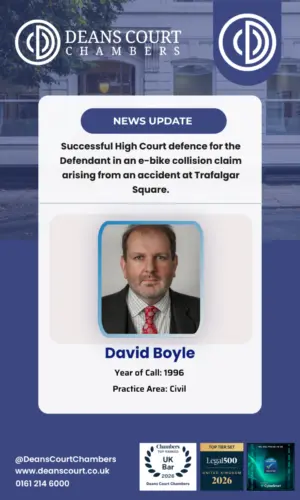
David Boyle was instructed by Jon Dutton at DWF LLP on behalf of the Defendant.
Key Takeaway
The standard required of a driver in a road traffic accident is not one of perfection, but one that is reasonable in all the circumstances.
David Boyle took A-levels in Maths, Physics and Chemistry before reading Law at Churchill College, Cambridge. He has a particular understanding of the applied mathematics and physics pertaining to road traffic collisions and is regularly instructed in cases involving accident reconstruction evidence.
Link to the full judgment to follow.
Also Recently
-
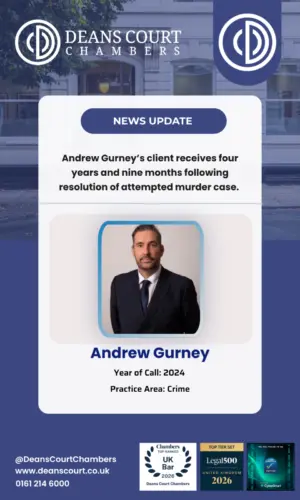
Andrew Gurney achieved a favourable outcome in a serious multi-handed case involving allegations of attempted murder.
Andrew Gurney achieved a favourable outcome in a serious multi-handed case involving allegations of attempted murder.Representing one of four defendants…
Nov 09
-
Deans Court Chambers wins Chambers of the Year at the Greater Manchester Pro Bono Awards.
We are delighted to share that Deans Court Chambers has been awarded Chambers of the Year at the Greater Manchester…

Nov 06